
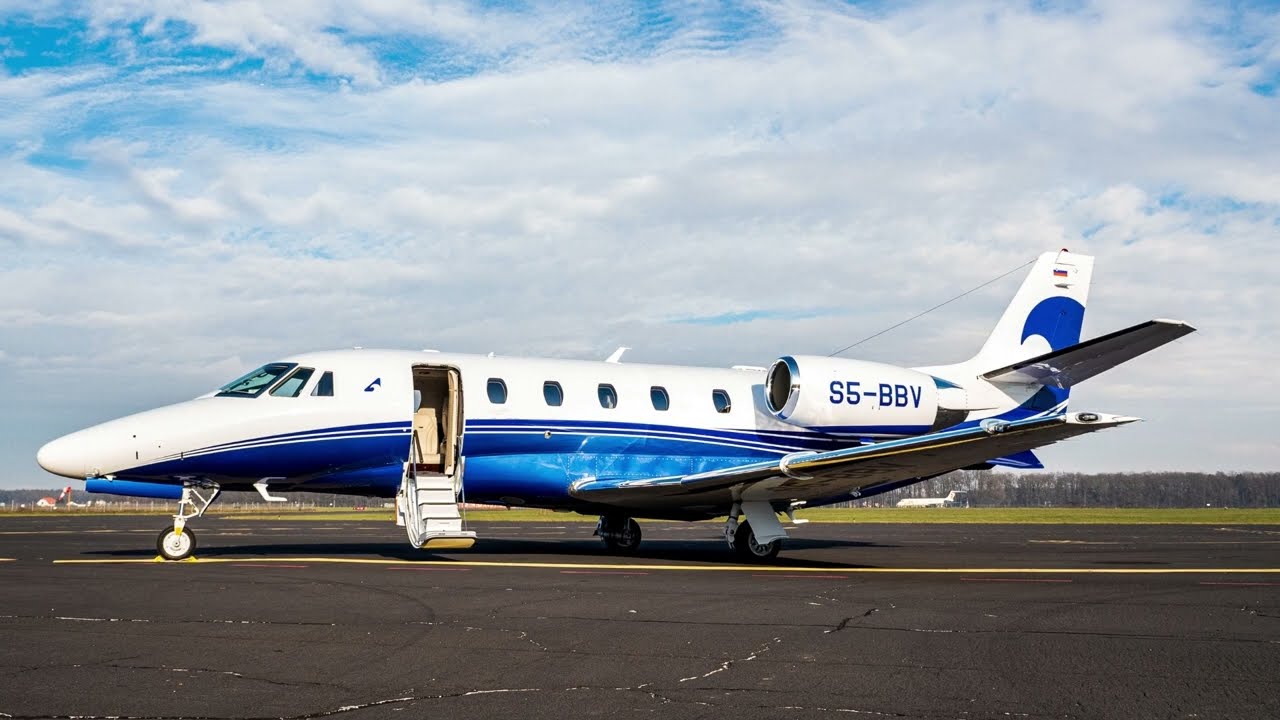
Citation Excel, XLS and XLS+ charter
The midsize benchmark, and the aircraft we recommend more than any other. It is the midsize jet whose hold keeps up with its cabin — six travel in comfort with a week of luggage, and eight fit when the group has to go together, which is rarer in this class than it should be.
Figures below are typical for the type; individual aircraft vary.
Send the trip and the bag list. We will tell you whether an XLS is the right aircraft, and what is if it is not.
See your estimate first. Nothing is sent until you choose to send it.
Two numbers explain the whole aircraft
Ninety cubic feet of hold, and 3,560 feet of runway. No other midsize jet has both, and between them they decide most of the trips people actually take out of Michigan.
The largest hold in the class, by a distance
About 80 cubic feet in the tailcone plus internal stowage, with an 800 pound limit. A Hawker 900XP seats the same eight people and carries roughly 50 cubic feet capped at 395 pounds. That is not a small gap; it is the difference between a week in Florida working and not.
The shortest takeoff of any midsize jet
Around 3,560 feet. That opens Naples, Boca Raton, Aspen and most of northern Michigan, where larger midsize aircraft are marginal with a full load or excluded outright.
A real stand-up cabin
18.5 feet long, 5.7 wide and 5.7 tall down a dropped aisle. Not the largest in the class — the Hawker is wider and taller — but genuinely stand-up, which the CJ line is not.
It is everywhere, which keeps it affordable
Nearly 1,000 Excel, XLS and XLS+ airframes were built and the type is common in Michigan. A widely available aircraft is a competitively priced one, and it is often already at your departure airport.

Where the XLS runs out, and it does run out
Published range is about 2,100 nautical miles. Operators plan real trips at roughly 1,400 to 1,700 once you account for passengers, reserves and winds. From Pontiac that is most of the country — but not the west coast with a full cabin, and pretending otherwise is how people end up with an unexpected fuel stop.
Great-circle distances from Oakland County International (PTK). Destinations drawn in amber sit beyond practical planning range with a full cabin and normally mean a fuel stop, a lighter load, or a different aircraft. Everything in blue is comfortable.
Excel, XLS or XLS+ — what actually differs
One airframe, three iterations, and quotes rarely explain which one you are being offered. The cabin and the hold are essentially identical across all three; the differences are in the engines and the flight deck.
Citation Excel — 1998 to 2004
The original. PW545A engines and the Honeywell Primus 1000 flight deck. Climbs more slowly than the later aircraft and historically needed a step climb to reach altitude. Around 370 built. The cabin is the same one you get on an XLS+.
Citation XLS — 2004 to 2009
Uprated PW545B engines, updated avionics and a 200 pound weight increase. Reaches 43,000 feet in about 25 minutes, roughly 48 minutes faster than the Excel. Around 329 built. The version you will see most often on charter.
Citation XLS+ — 2008 onward
PW545C engines, a redesigned nose and Collins Pro Line 21 avionics, with Garmin G5000 upgrades available. Still in production. The best-performing of the three, and the one to ask for if the trip is near the limits.
For most trips the generation barely matters. Where it does is a hot day, a short runway or a long sector — all three of which are exactly when you want the newest engines. Ask which variant is being quoted; it is a fair question and a good operator will answer it plainly.
Citation XLS+ specifications
Typical figures for the XLS+. Excel and XLS differ mainly in engines, climb performance and avionics.
| Passengers | 8 standard, 9 on some tails |
| Cabin length | 18.5 ft |
| Cabin width | 5.6 ft |
| Cabin height | 5.7 ft, dropped aisle |
| Cabin volume | approx. 461 cu ft |
| Baggage volume | 90 cu ft (80 external) |
| Baggage weight limit | approx. 800 lb |
| Maximum range | approx. 2,100 nm |
| Practical planning range | 1,400–1,700 nm |
| Max cruise | 441 kt |
| Takeoff distance | approx. 3,560 ft |
| Landing distance | approx. 3,619 ft |
| Engines | 2 × Pratt & Whitney PW545C |
| Avionics | Rockwell Collins Pro Line 21 |
When to take it, and when not to
Take it: six people and a week of luggage
Michigan to Florida with a family and full suitcases is the XLS’s trip. Ninety cubic feet is the difference between everything fitting and a conversation at the FBO nobody wants to have. Eight fit too, on the bench — fine to Chicago, a long afternoon to Naples.
Take it: short or restricted runways
Naples, Boca Raton, Aspen, Charlevoix, Harbor Springs. Anywhere the field decides the aircraft, this is usually the answer that still has a proper cabin and a proper hold.
Think hard: the west coast with a full cabin
Seattle, Los Angeles and San Diego from Michigan sit beyond practical planning range with eight aboard. It can be done with a stop or a lighter load, but a Challenger 350 or a Hawker does it nonstop.
Look elsewhere: tall passengers on a long sector
The Hawker cabin is wider and taller and holds about 90 more cubic feet of volume. On a three-hour leg with six adults that is felt. The XLS wins on baggage; the Hawker wins on room.
Not sure which of the two your trip wants? Send the route, the passenger count and the bag list. That answers it in about a minute, and it is the same question either way.
Get aircraft optionsCitation XLS charter
How much luggage fits in a Citation XLS+?
About 90 cubic feet, roughly 80 of it in an external tailcone compartment and the rest internal, with a limit around 800 pounds. That is the most in the midsize class and close to double a Hawker 800XP or 900XP, which seats the same number of people. In practice it takes ten full-size cases, or six cases and two sets of golf clubs.
What is the range of a Citation XLS+?
Textron publishes about 2,100 nautical miles at maximum economy. Operators plan real missions at roughly 1,400 to 1,700 nautical miles depending on passengers, reserves, winds and routing. From Michigan that covers Florida, the Northeast, Texas and the mountain west comfortably. The west coast is at the edge and frequently needs a fuel stop with a full cabin.
How short a runway can an XLS+ use?
Around 3,560 feet for takeoff and 3,619 to land, which is the shortest takeoff distance of any midsize jet. That is why it works at Naples, Boca Raton and Aspen where larger midsize aircraft are marginal or excluded, and it is a large part of why it gets recommended so often.
What is the difference between the Excel, XLS and XLS+?
One airframe, three generations. The Excel was built from 1998 to 2004. The XLS followed in 2004 with updated avionics, more thrust and a 200 pound weight increase. The XLS+ arrived in 2008 with PW545C engines, a redesigned nose and Collins Pro Line 21. Cabin and baggage are essentially unchanged across all three, so the differences matter more for climb performance and avionics than for what you experience in the seat.
Is a Citation XLS+ better than a Hawker 900XP?
Neither is better; they trade different things. The Hawker has the larger cabin by volume and roughly 600 nautical miles more range. The XLS+ carries nearly double the luggage, uses about 1,500 feet less runway, and reaches airports the Hawker cannot. For a family going to Florida for a week the XLS+ is usually the right answer. For six executives on a longer sector the Hawker often is.
How many passengers does an XLS+ seat?
Eight in a normal executive layout, with nine on some aircraft counting the belted lavatory or a divan. Six is where it is comfortable on a longer leg; eight is a full cabin with the side-facing bench in use. What sets it apart is that the hold keeps up with the cabin, which most midsize jets cannot say, and that is the reason it is the benchmark in this class.
Comparing across the whole midsize field? There is a guide to choosing for six to eight passengers, and a baggage and runway comparison covering thirty-four aircraft.
Send the trip and I will size the aircraft to it.
Route, dates, passenger count and what you are carrying. You get aircraft options with the operating carrier named, its certificate and insurance verified, and the full cost split into the operator’s price and my advisory fee.